

Direct vs Indirect Lighting — When to Use Each
- Mar 8, 2019
- 2 min read
Updated: Jul 31
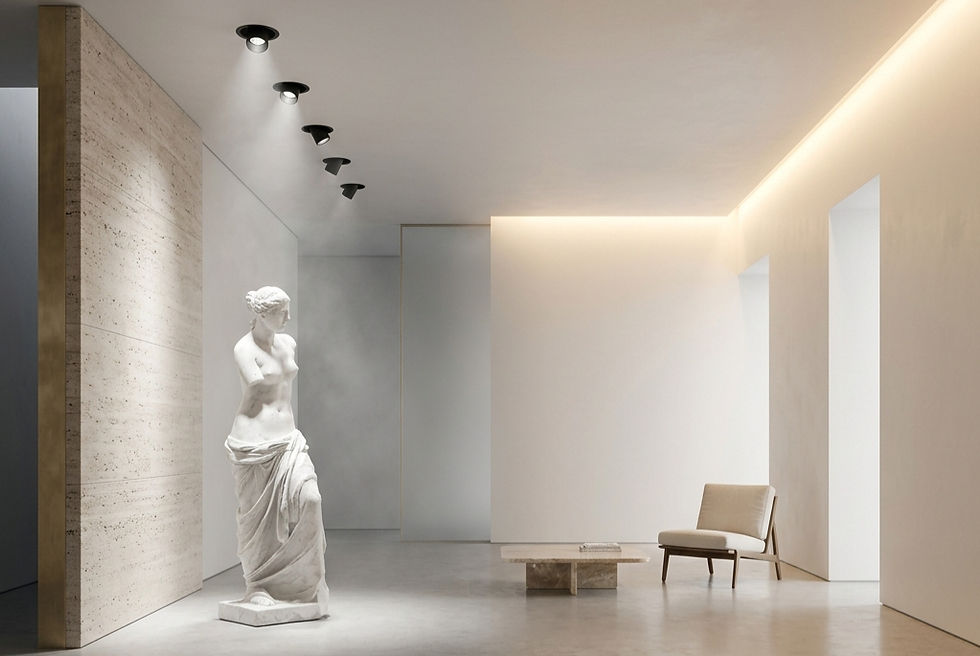
All luminaires do one of two things — or a combination of both. They send light directly toward a surface or task. Or they send it toward a ceiling or wall first, allowing it to bounce into the space as diffuse, reflected illumination. The distinction between these two approaches — direct and indirect lighting — is one of the most consequential choices in any lighting scheme.
Direct lighting is efficient, precise, and high in contrast. Light travels from source to surface without interruption, maintaining intensity and directionality. It is the language of task lighting, accent lighting, and architectural highlight. It creates shadow, which means it reveals texture, defines form, and draws the eye to specific points in a space. In retail, direct lighting makes products compelling. In galleries, it makes art vivid.
Indirect lighting is soft, diffuse, and low in contrast. By bouncing light off a ceiling or wall before it enters the occupied zone, it eliminates harsh shadows and reduces glare significantly. The ceiling becomes a large secondary source, emitting light across a wide area. Indirect schemes feel calm, spacious, and comfortable for extended occupation — which is why they are the foundation of quality office lighting, healthcare environments, and upscale hospitality.
The risk of pure direct lighting is harshness. High contrast without relief becomes visually fatiguing. The risk of pure indirect lighting is flatness. Without shadow or directional accent, a space can feel uniform to the point of being characterless — every surface equally bright, nothing drawing the eye.
The skill — and it is a skill — lies in understanding what ratio of direct to indirect a specific space, at a specific time of use, actually requires. A boardroom benefits from predominantly indirect ambient light with direct task illumination at the table. A restaurant reverses the ratio — intimate indirect surround with direct, focused accent on the table surface.
Direct light tells you where to look. Indirect light tells you how to feel.


Comments